
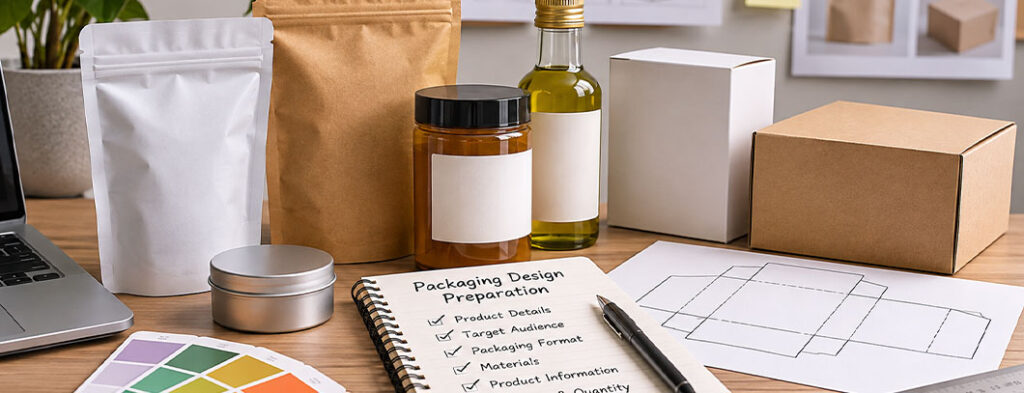
Launching a new product involves more than developing a good product and finding customers. How your product is presented, protected and recognised in the market also plays an important role. This is where effective packaging design becomes essential.
For startups and businesses introducing new products, preparing for packaging design early can save time, reduce unnecessary costs and help avoid production problems later.
Whether you are launching a food product, beverage, cosmetic, personal care item or consumer product, understanding the packaging requirements before starting the design process will help you make better decisions.
So, what should you prepare before starting a packaging design project?
1. Understand Your Product and Its Packaging Requirements
The first step is to understand the product itself. Packaging should be designed around the product’s physical characteristics, storage requirements, intended use and market positioning.
Before approaching a packaging designer, consider:
- What type of product are you launching?
- Is it liquid, solid, powdered, frozen or perishable?
- Does it require special storage conditions?
- Does it need protection from moisture, light or external damage?
- How will customers use, open and store the product?
- Will it be sold individually or as part of a product range?
For example, packaging for a food product may require different materials and storage considerations compared with cosmetics, beverages or household products.
Having a clear understanding of your product helps determine the most suitable packaging format and design approach.
2. Identify Your Target Market and Customers
Packaging design should communicate with the people who are most likely to purchase your product.
A product targeting premium consumers may require a different visual approach from one positioned for everyday convenience or affordability.
Consider:
- Who are your intended customers?
- What age group or customer segment are you targeting?
- Where will your product be sold?
- Is your product positioned as premium, affordable, natural or specialised?
- Who are your main competitors?
- What makes your product different?
Understanding your target audience helps establish the visual direction, packaging style, colours, typography and overall brand presentation.
A good packaging design should not only look attractive but also communicate the right message to the intended customer.
3. Decide on the Packaging Format and Materials
Before starting the artwork, you should have a general idea of how your product will be packaged.
Packaging formats vary depending on the product category, production requirements, distribution method and budget.
Some common packaging formats include:
- Folding cartons and printed boxes
- Flexible pouches and sachets
- Bottles and jars
- Labels and sleeves
- Stand-up and resealable pouches
- Corrugated shipping boxes
- Food containers and trays
The packaging material also influences the design and printing process.
For example, paperboard, corrugated board, plastic, glass and flexible packaging each have different printing, finishing and production requirements.
You do not necessarily need to finalise every technical detail before approaching a designer. However, having an idea of the packaging format and preferred materials will help establish the project scope.
4. Prepare Your Brand Identity and Product Information
Your packaging is one of the most visible expressions of your brand. It should communicate a consistent identity across your products and other marketing materials.
If you already have an established brand, prepare the following:
- Company or brand logo in a high-resolution or vector format
- Brand colours and typography, if available
- Existing brand guidelines
- Product name and product category
- Product descriptions
- Product images or illustrations, if required
You should also prepare the information that needs to appear on the packaging.
Depending on the product and applicable regulations, this may include:
- Ingredients or material composition
- Net weight or volume
- Manufacturing and expiry dates
- Usage instructions
- Storage instructions
- Manufacturer or distributor details
- Barcode and product identification
- Required regulatory information and certifications
The exact information depends on the product category and the market where it will be sold.
For businesses without an established visual identity, it may be worth developing the brand identity before proceeding with product packaging design. This helps ensure that the packaging reflects a consistent and recognisable brand.
Explore our Brand Identity Design services to understand how a professional brand identity can support your product presentation.
5. Understand Packaging Dimensions and Technical Requirements
One of the most important preparations before starting packaging artwork is obtaining accurate packaging dimensions.
Your designer needs to understand the physical structure of the packaging before preparing the artwork.
Depending on the packaging type, this may include:
- Width, height and depth
- Bottle or container dimensions
- Label dimensions and application area
- Folding and cutting requirements
- Sealing and joining areas
- Available printing areas
For printed packaging such as cartons, boxes and sleeves, manufacturers generally provide a technical template known as a dieline.
A dieline indicates the cutting, folding and other structural areas required to prepare print-ready packaging artwork.
If you are working with a packaging manufacturer, ask whether they can provide the dieline or technical specifications before the design process begins.
Using incorrect dimensions or an outdated template can result in artwork adjustments, printing errors and unnecessary production delays..
6. Consider Printing Methods and Production Requirements
Not all packaging can be produced using the same printing method. The choice of printing process depends on the packaging material, quantity, colour requirements, finishing options and production budget.
This is particularly important for startups considering flexible packaging such as printed pouches and sachets.
Common packaging printing methods include:
- Flexographic printing: Commonly used for flexible packaging, labels and other packaging materials. It is generally more economical for larger production volumes.
- Gravure printing: Widely used for high-volume flexible packaging production, particularly where consistent, high-quality printing is required across large quantities.
- Offset printing: Commonly used for folding cartons, paperboard packaging and other printed materials.
- Digital printing: Can be a suitable option for short production runs, depending on the packaging material, supplier capabilities and available technology.
- Screen printing: Used for selected packaging applications where specialised ink application or printing effects are required.
An Important Consideration for Startups Choosing Pouch Packaging
If you are a startup planning to launch a product in flexible pouches, it is important to understand the minimum order quantities associated with different printing methods.
Flexographic and gravure printing generally require significant initial setup investment, including printing plates or cylinders. As a result, they are usually more cost-effective for businesses ordering large quantities of printed pouches.
For a startup launching a new product with limited production volumes, ordering fully printed pouches may involve higher initial costs and minimum order quantities that exceed its immediate requirements.
A practical alternative is to use plain or pre-manufactured stock pouches with professionally designed and printed sticker labels.
This approach allows startups to:
- Start with smaller production quantities.
- Avoid the high initial setup costs of conventional pouch printing.
- Introduce different product flavours or variations more easily.
- Update product information or branding without ordering entirely new printed packaging.
- Test market demand before investing in large-scale printed packaging.
As the business grows and production volumes increase, it can consider moving towards custom-printed pouches using flexographic, gravure or other suitable printing technologies.
The important thing is to select a packaging and printing solution that matches your current production volume, budget and future business plans.
You should also consider whether your packaging requires additional finishing techniques such as foil stamping, embossing, debossing or spot UV.
Discussing these requirements with your packaging supplier and designer early in the process helps ensure that the artwork is prepared correctly and that your chosen packaging solution is commercially practical.
7. Establish Your Packaging Design Budget
Packaging design and packaging production are two different costs that should be considered separately.
Your overall budget may include:
Packaging design costs
- Concept development
- Packaging layout and artwork design
- Product variations
- Revisions and artwork adaptations
- Final print-ready artwork preparation
Packaging production costs
- Packaging materials
- Printing and finishing
- Cutting, folding and assembly
- Minimum order quantities
- Prototypes and production samples
When planning your packaging budget, consider both the initial launch and future production requirements.
For example, a startup launching three product flavours may need a packaging system that can accommodate additional flavours or sizes later.
Discussing these requirements at the beginning can help create a more flexible and cost-effective packaging design solution.
8. Prepare Your Packaging Design Brief
Once you have gathered the essential information, the next step is to communicate your requirements clearly to the packaging designer.
A packaging design brief helps establish the project scope, creative direction and technical expectations.
Your brief should ideally include:
- Business and brand information: Introduce your business, brand and product.
- Product details: Explain the product type, features and intended use.
- Target audience: Describe the customers you want to reach.
- Packaging requirements: Specify the preferred packaging format and materials, if known.
- Design direction: Share your preferred visual style, colours and design references.
- Product information: Provide the text, images, logo and other required content.
- Production details: Include available dimensions, dielines, printing specifications and manufacturer details.
- Budget and timeline: Establish your expected investment and product launch schedule.
You do not need to have every technical detail finalised before approaching a packaging designer. However, providing as much information as possible makes the design process more organised and productive.
9. Choose a Packaging Design Partner Who Understands Production
Packaging design is not simply about creating attractive graphics. It requires an understanding of branding, product presentation, packaging structures, artwork preparation and printing requirements.
When selecting a packaging design agency or designer, consider their experience in:
- Product packaging design
- Packaging artwork development
- Product label design
- Brand identity and visual communication
- Print production and artwork preparation
- Managing multiple product variations
Reviewing previous packaging design projects can also help you understand the designer’s creative approach and technical capabilities.
For startups, working with a design partner who understands both creative design and print production can make the transition from concept to finished packaging much smoother.
Final Thoughts
Preparing for packaging design before launching a product can make a significant difference to your branding, production planning and overall product presentation.
You do not need to have every decision finalised before starting. However, understanding your product, target audience, packaging format, brand identity, technical requirements and budget will give your designer a much clearer starting point.
At DesignzHub, we understand that every product and business has different packaging requirements. Our Product Packaging Design services focus on creating professional packaging artwork that communicates your brand, presents your product effectively and is prepared with production requirements in mind.
Planning to launch a new product? Start with the right packaging strategy and build a visual identity that helps your product stand out.
Frequently Asked Questions
Packaging design should be considered during the early stages of product development, before finalising packaging production. This allows businesses to evaluate packaging formats, materials, dimensions, branding and printing requirements.
Ideally, provide your product details, brand logo, target audience, product information, preferred packaging format, design references and available technical specifications. A clear project brief also helps establish the design direction.
Having a logo and established brand identity is beneficial because packaging should maintain visual consistency with the overall brand. However, if your business does not have an established identity, brand development can be considered before or alongside packaging design.
The cost depends on the packaging format, design complexity, number of product variations, artwork requirements and revisions. Packaging design fees are generally separate from printing and manufacturing costs. It is best to request a quotation based on your specific project requirements.
A packaging dieline is a technical template that shows the cutting, folding and structural layout of a packaging item. Designers use it to position artwork correctly and prepare files for packaging production.
Yes. A consistent packaging design system can be developed for multiple product variations. The overall brand layout remains consistent while product names, colours, descriptions and other relevant details are adapted for each variant.
It is generally advisable to identify your packaging manufacturer or production supplier early. Their technical specifications, available materials, printing methods and dielines can influence the design and final artwork preparation.
Related Reading
CMYK vs Pantone: Understanding Spot Colours, Process Printing & Colour Accuracy
CMYK vs RGB: Understanding Colour Modes for Print & Digital Design
Why You Should Avoid Borders in Print Design (And What to Do Instead)
Understanding Dielines: The Blueprint for Perfect Packaging Design
Common Packaging Design Mistakes FMCG Brands Make (And How to Avoid Them)
How to Prepare Your Product for Export with Professional Packaging Design